You Don’t Have to Choose: The Truth About Licensing and POD
Do you have to choose between print on demand and licensing? No. Here is the truth about running both income streams as a surface pattern designer.
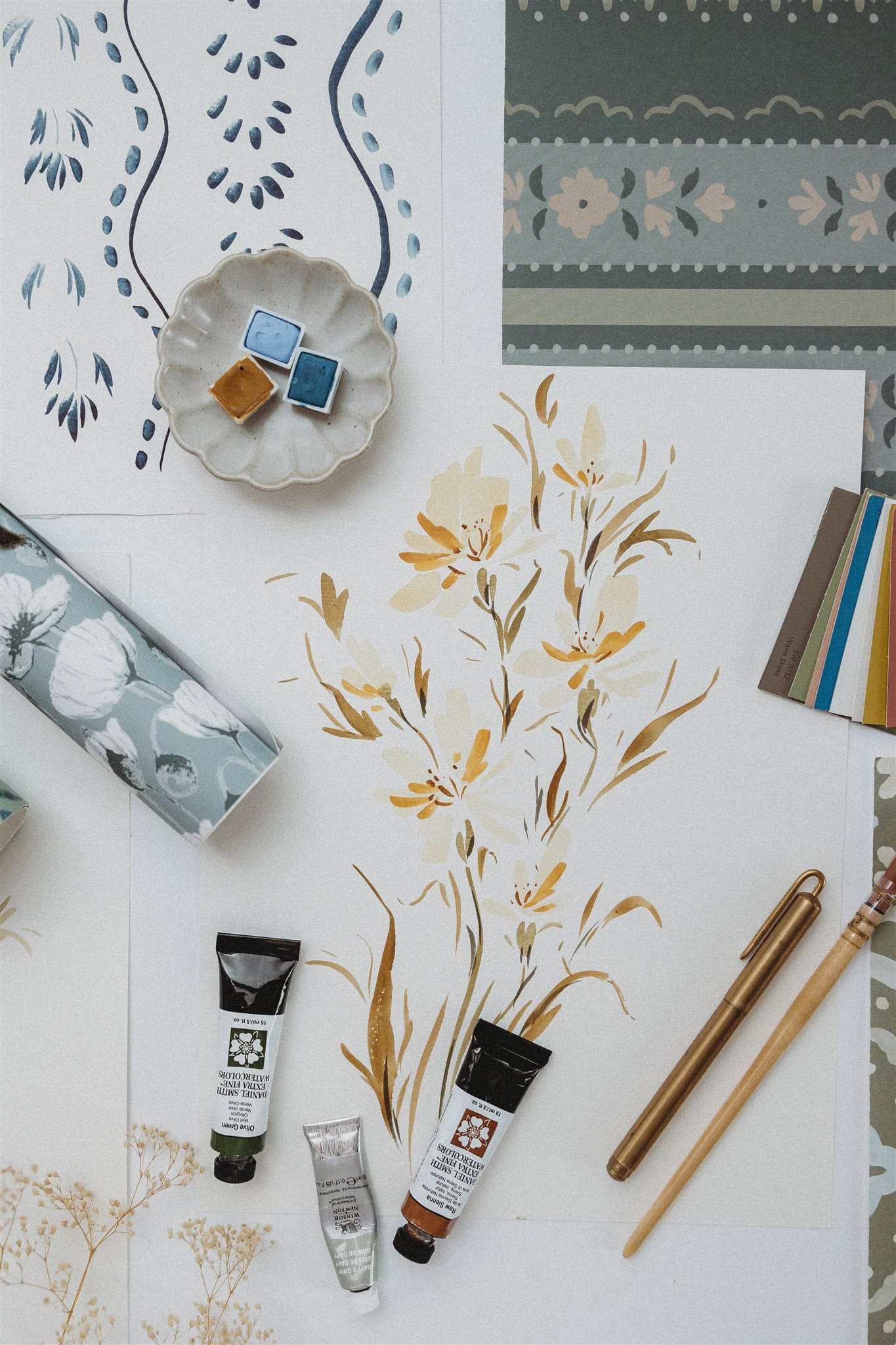
You Don’t Have to Choose: The Truth About Licensing and POD
If you have been told to pick one or the other, this is your permission slip to do both.
When I first started in surface pattern design, the advice I kept hearing was some version of the same thing: pick a niche, find your style, focus on one product. Stay in your lane.
It never felt quite right to me.
Because even early on, I could see it. The same artwork, the same pattern, working beautifully across a throw pillow, a wallpaper panel, a set of stationery, a fabric by the yard. With a color palette shift or a scale adjustment, even more options opened up. One design was never just one thing. It was a starting point with an entire ecosystem of possibility attached to it.
I also had not fully found my style yet and I have come to believe that we never fully do, not if we stay curious. We continue to evolve endlessly when we allow it. Locking yourself into one lane before you have had a chance to explore feels like putting walls up before you have even seen the view.
So that is why I started doing things differently. And why I now encourage other creatives to do the same.
Instead of limiting your opportunities to only POD, or only licensing, or only manufacturing, I want to invite you to dive deep into each one individually. Learn it. Find what works for you, because everyone’s path will look different. Then learn the next and let them work together as complements to each other, not competitors.
I make great income through licensing. I also earn consistently through Spoonflower and dropshipping. These streams do not pull against each other. They hold each other up.
Here Is What Is Actually True
POD and licensing are not competing income streams. They are different systems that serve different purposes and a well-built creative business can run both at the same time.
Print-on-demand is your always-open storefront. Your designs live there, earning royalties whenever someone finds them and places an order. You are not pitching. You are not waiting on a contract. Your work is just out in the world, available.
Licensing is your relationship-based income. A brand chooses your design, pays you a fee, and puts it on a product they produce, market, and sell. You are not handling inventory, production, or shipping. You create the work once and get paid for the rights to use it.
These two models are not in conflict. They are designed to run in parallel.
Let Me Make This Real
Example one. You have a botanical collection on Spoonflower. It sells steadily on fabric and wallpaper. A stationery brand reaches out after finding your Instagram. They want to license three of those patterns for a journal line. You sign a non-exclusive agreement, meaning your Spoonflower shop stays open and those designs keep earning royalties while the brand sells their journals. Two income streams. Same designs.
Example two. You have been building a shop on Society6 and earning passive income from pillow covers and art prints. You decide to pitch a home goods brand with a curated collection of six patterns. The brand loves two of them and offers you a licensing deal for their table linen line. Your Society6 shop is untouched. The licensed designs are earning in a completely different channel. Nothing conflicts.
Example three. You license a pattern to a baby brand on a two-year exclusive agreement for the baby apparel category. That exclusivity covers one category. Your Spoonflower shop still sells the same pattern on fabric and wallpaper. Your Etsy shop still sells it as a digital download. The brand has exclusivity over their product type. You have everything else.
This is how it actually works.
The One Thing That Changes the Math
The only time POD and licensing create a real conflict is when exclusivity is involved and you are not paying attention to the terms.
If you sign an exclusive licensing agreement, the designs covered in that agreement cannot be sold or licensed elsewhere during the term, and sometimes within the category, the territory, or across the board depending on how the contract is written. That is real and it matters.
But here is what most artists do not realize: exclusivity is negotiated, not automatic. Brands ask for it because it protects their investment. You agree to it because the compensation reflects the restriction. When you sign non-exclusive deals, which is far more common than you might think, your designs stay available everywhere else.
This is exactly why reading your contracts carefully is not optional. Know what you are giving up, for how long, and in what category. Ask questions before you sign and when exclusivity is on the table, price it accordingly. The Graphic Artists Guild Handbook is one of the most referenced resources in the industry for understanding licensing structures and is a solid starting point.
A Few Practical Tips for Running Both Well
Keep designs active on at least one POD platform. It does not have to be perfectly optimized or fully stocked. Even a focused shop with your strongest designs keeps passive income flowing while you build the licensing side.
Use your POD sales as proof. When you approach brands, a pattern that has sold consistently on Spoonflower or Society6 is evidence that people want it. That data makes your pitch stronger.
Read every contract before you sign. Not just the payment terms. The exclusivity clause, the territory, the term length, and what happens when the agreement ends. You do not need a lawyer for every deal, but you do need to understand what you are agreeing to.
Price non-exclusive and exclusive licensing differently. When you give a brand exclusive rights, you are limiting your own ability to earn elsewhere with that design. That restriction has a value. Charge for it.
Design with both channels in mind. Patterns that work well in a POD shop, strong repeat, versatile colorways, clean execution, are also the patterns that attract licensing interest. Building one portfolio serves both opportunities.
You Are Building an Ecosystem, Not Making a Choice
The artists I have watched build sustainable creative businesses are rarely doing just one thing. They are not choosing POD over licensing or licensing over POD. They are building a body of work that can move through multiple channels, earn in multiple ways, and grow across multiple relationships.
That is the income diversification that actually holds.
Your designs are not single-use. Your creativity is not a finite resource you have to ration between platforms. The more places your work lives, the more doors open.
So if you have been waiting for permission to pursue both, here it is.
Start where you are. Keep creating and sharing. Let your work move into every space it belongs.
Ready to Go Deeper?
If you are building toward a licensing side of your business alongside your POD presence and want a community of artists doing the same work right alongside you, The Creative Mentorship was built for exactly this. We cover design foundations, marketing, mindset, and licensing inside a community of working surface pattern designers.
Learn more at The Creative Mentorship
Melissa Johnson is a watercolor artist, surface pattern designer, and creative educator based in central Illinois. Her work has been licensed with brands including Minted, Sophistiplate, Golden Coil, Casely, and more.
share on